

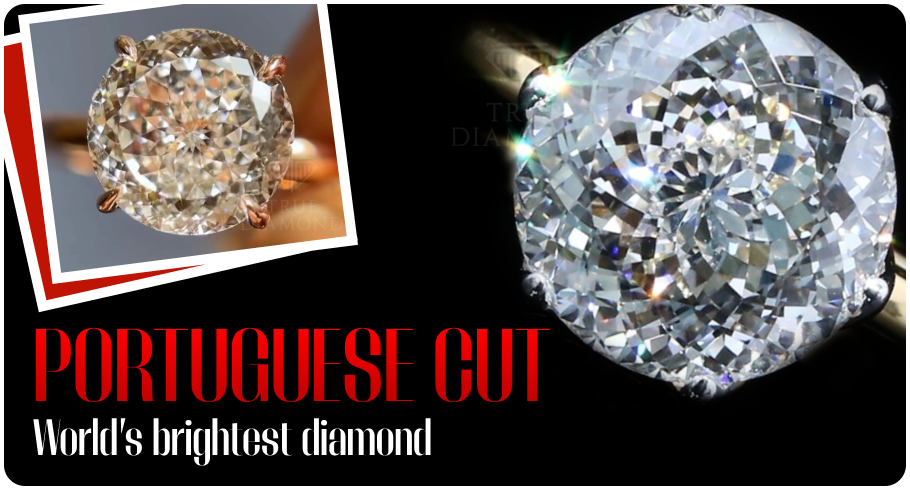
The 4 Ct Portuguese Cut Big Rock Solitaire Ring featuring 160+ facets. The light it produces is the first thing anyone notices about an expensive ring.
Someone across the room looks at your hand. In under two seconds, they have formed an opinion. Not about the certificate, not about the carat weight — just about whether that ring looks expensive or not. That judgment is instinctive and almost entirely visual.
So what are they actually responding to? We have built enough rings at True Diamond to know that the answer is never singular. An expensive-looking ring is always the result of several design decisions working in harmony. Get one wrong and it undoes the others. Get all of them right and even a modest-carat stone can command a room. This guide breaks all of it down. Practically, visually, and honestly.
01 Cut Quality — Not Carat Weight
This is the one that surprises most buyers.A poorly cut 1.5 carat diamond will look flatter and smaller than a superbly cut 1 carat diamond. Light return is everything, and light return is entirely a function of cut.
When a diamond is cut to ideal proportions — correct table percentage, proper depth, well-aligned facets — light enters the stone and bounces directly back to the eye. The result is that signature blaze of white light. When cut is poor, light leaks out the bottom and the sides. The stone looks lifeless from any distance beyond arm's length.
At True Diamond, every stone starts at EF colour and VVS clarity, and cut is never compromised. The Portuguese cut — our most talked-about stone — takes this further than any other cut available in India. With 160 or more facets arranged in layered concentric rows, it produces a quality of light that a standard round brilliant simply cannot. Not just more sparkle: a different kind entirely. Deeper. Shifting. The kind that catches light from across a room.

Portuguese Cut 4 Ct Big Rock Solitaire Ring
160+ facets. EF VVS. IGI certified. 14K gold. The only Portuguese cut lab diamond solitaire offered in India — and the clearest example of what a perfect cut actually looks like on the hand.
02 Metal Finish and Setting Precision
The diamond may be the star but the setting is the frame. A careless frame makes the best painting look cheap. The same principle applies to rings. There are two things a trained eye picks up almost immediately on the metal: finish quality and setting precision.
Finish quality: Finish quality is about how the gold has been worked. High-polish 18K gold reflects cleanly and evenly. You see the ring, not the surface. Rings with inconsistent polish or tool marks — even subtle ones — look mass-produced.
Setting precision: Setting precision is about the prongs. Sharp, fine prongs that sit flush with the diamond and taper to a clean point: expensive. Large, bulky, uneven prongs that dominate the centre stone: cheap regardless of what the stone costs.
| What to Look At | Expensive-Looking | Cheap-Looking |
|---|---|---|
| Metal finish | Consistent high-polish; no visible tool marks | Dull, uneven — or over-polished to look shiny |
| Prong work | Fine, sharp, flush to the stone, even across all prongs | Thick, uneven, or towering over the diamond's table |
| Metal transitions | Smooth flow between band, gallery, and head | Visible seams, rough edges, or abrupt transitions |
| Underside of ring | Finished as carefully as the top | Rough, unfinished interior |
| Metal colour | Consistent across entire piece | Plated alloy — colour varies with wear |
At True Diamond, we work exclusively in 14K and 18K gold — never plated alloy. The difference is immediately visible when rings are compared side by side, and it is even more obvious after six months of daily wear.

Ryana 2 Ct Oval Hidden Halo Solitaire Ring
The hidden halo sits beneath the centre stone, invisible from above but throwing light upward around the diamond's girdle.A masterclass in precision — fine prongs, high-polish 18K gold, and an underside finished as carefully as the crown.
03 Colour Grade — What the Eye Actually Sees
Diamond colour is graded on a scale from D (completely colourless) to Z (visibly yellow). A diamond graded K or below reads as noticeably warm — not vintage-romantic warm, but yellow in a way that immediately signals a lower price point.
The sweet spot for maximum visual impact is EF colour. These stones appear completely colourless under any light, in any setting, on any skin tone. This is the grade True Diamond builds around — not because the certificate looks better, but because the visual result is unambiguously superior and immediately readable.
The most common diamond mistake in India is spending on carat weight and compromising on colour. A large yellow stone does not look expensive. A smaller white one does.
04 Proportions — Size Is Not the Same as Presence
A ring that looks expensive has presence. Presence is not size. Presence is the result of proportions working correctly. Elongated cuts — oval, pear, emerald, marquise — create finger presence that reads as more expensive than the carat weight alone would suggest.
An oval diamond faces up approximately 15% larger than a round brilliant of the same carat weight, because of how its surface area is distributed.
| Diamond Shape | Face-Up Presence | Expensive-Looking? |
|---|---|---|
| Oval | Largest per carat. Elongated and elegant. | ✓ Extremely |
| Pear | Teardrop elongation reads large on hand | ✓ Very |
| Emerald | Wide table, architectural. | ✓ When cut well |
| Round Brilliant | Compact but maximally brilliant | ✓ Classic expensive |
| Portuguese Cut | Deep, layered fire. Commands attention differently. | ✓ Uniquely expensive |

Eleanor 5 Ct Solitaire Ring
A 5-carat centre stone with proportions calibrated for maximum presence. Setting height, band width, and prong placement all considered together.
05 The Setting Design — Restraint vs Overdesign
There is a counterintuitive truth about expensive rings: they are almost never overdesigned. Luxury jewellery is about restraint and proportion. Rings that look expensive are rarely the ones packed with the most detail.
Overdesign is one of the most common mistakes in mass-market jewellery — excessive swirls on the band, pavé that is slightly too dense, halos that are slightly too large for the centre stone. Each element might look fine in isolation. Together they compete and the ring reads as busy rather than refined.
The settings that make a ring look expensive tend to have one clear focal point and everything else in service of it. A hidden halo is a perfect example. From above, it looks like a clean solitaire. The detail only reveals itself when the ring moves or catches light from below. The most expensive-looking rings are almost never the most complex. They are the most considered.

Ariana Grande's Toi et Moi — 2 ct Diamond + 0.5 ct Pearl
Two stones. One design intention. The Toi et Moi format is the clearest example of restraint producing an expensive result — the asymmetry reads as intentional, never cluttered.
06 Certification — Not Just a Paper, a Visual Signal
An IGI-certified diamond has had its cut, colour, clarity, and carat independently assessed by one of the world's most respected gemological laboratories. The certificate number is laser-inscribed on the diamond's girdle — verifiable with any jeweller's loupe. That laser inscription is permanent. It is the ring's identity, and it cannot be faked.
At True Diamond, every lab grown diamond above 0.50 carats comes with an IGI certificate. Our baseline is EF colour and VVS clarity — not because these grades are required, but because they are the foundation of a ring that looks undeniably expensive today and twenty years from now.

True Diamond Titanium Collection
Aerospace-grade Grade 2 Titanium — the same alloy in SpaceX rockets and fighter jets. Set with lab-grown diamonds. Built for men who want a ring that looks expensive because it was built to a standard nothing else meets.
The Six-Second Checklist
| # | What to Check | What Expensive Looks Like |
|---|---|---|
| 1 | Cut grade on the certificate | Excellent or Ideal — no compromise |
| 2 | Stone colour under natural light | Visibly white, no warmth or yellow tint to the naked eye |
| 3 | Prong work up close | Fine, sharp, flush with the diamond, even across all prongs |
| 4 | Metal finish consistency | No dull patches, no tool marks, colour even across the entire piece |
| 5 | The underside of the ring | Finished as cleanly as the top — expensive rings are expensive everywhere |
| 6 | Certificate + laser inscription | IGI certificate with matching laser-inscribed number on girdle |
A ring that passes all six tells its own story before the price tag is mentioned. That is exactly the point.
Questions We Hear Most
Does a bigger diamond always look more expensive?
No. A poorly cut large diamond looks flatter and less alive than a well-cut smaller one. Carat weight creates potential. Cut quality determines how much of that potential is realised. Focus on cut first, carat second.
Can a lab grown diamond ring look as expensive as a natural diamond ring?
Yes — because a lab grown diamond is chemically and optically identical to a mined diamond. No one can tell the difference with the naked eye. What makes the ring look expensive is cut quality, colour, setting precision, and metal finish — all of which apply equally to lab grown and mined stones.
What metal makes a ring look the most expensive?
18K gold — white, yellow, or rose — consistently reads as premium. White gold with a rhodium finish looks closest to platinum. Yellow gold is having a strong moment in 2026. The metal that looks most expensive is the one worn with intention.
Does a halo setting make a ring look more expensive?
A well-proportioned halo genuinely amplifies the ring's presence. An oversized halo or one with poorly matched stones does the opposite. The hidden halo is the most refined version: it adds light without disturbing the clean visual of the solitaire from above.
How do I know if a ring looks cheap?
The fastest tells are: a yellow-tinted centre stone, large or uneven prongs, inconsistent metal finish with dull patches, a rough unfinished interior, and an oversized or poorly proportioned halo. These elements individually reduce perceived value. Together they are immediately readable — even to someone who has never bought a ring before.
What is the most expensive-looking ring style for men?
A men's ring looks expensive when the material is exceptional, the finish is immaculate, and the design is confident rather than decorative. True Diamond's Titanium Collection — Grade 2 aerospace titanium finished in gold and set with lab grown diamonds — is built on this principle.
Can I make a ring look more expensive without spending more?
Yes — by spending correctly rather than more. Reallocating budget from an unnecessary clarity upgrade (VS1 to VVS — invisible to the naked eye) toward a better cut grade or cleaner setting design will produce a visibly more expensive-looking ring for the same total price.


